Image2Studio
Prompts

gpt-image-2

奢华双语品鉴菜单摄影

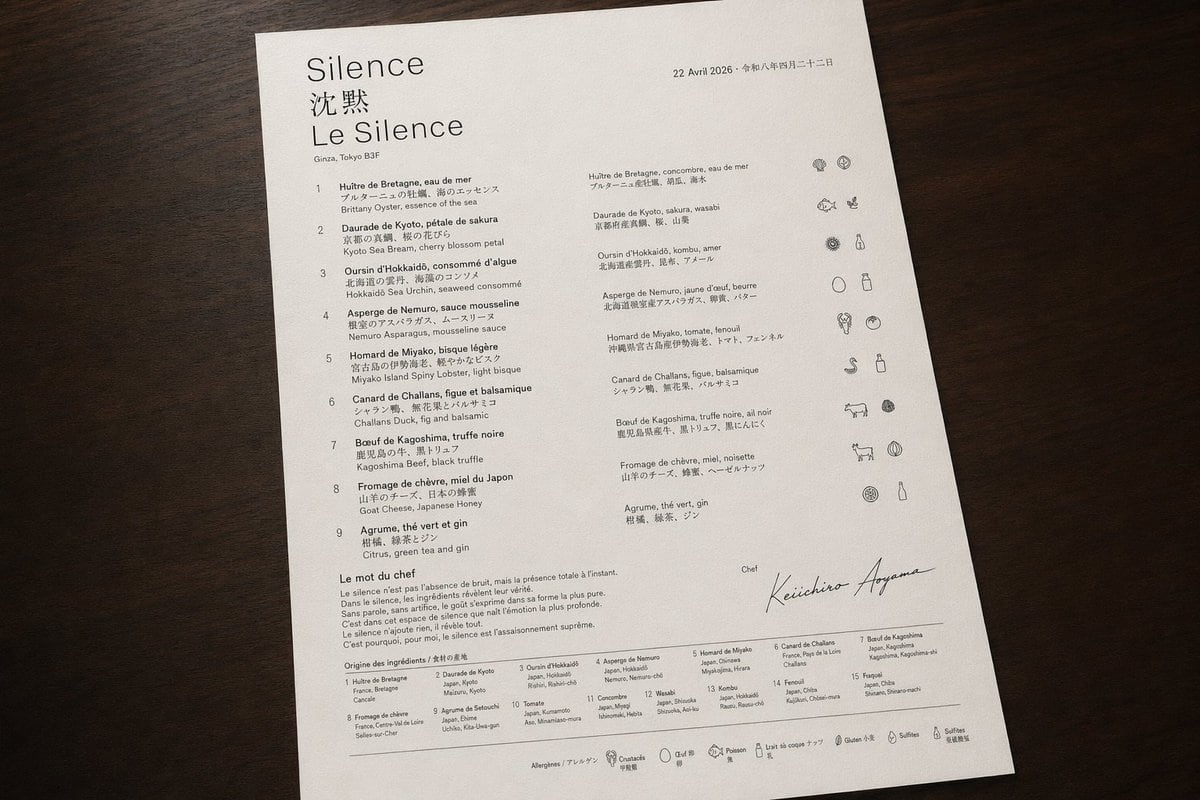
一张写实的俯拍照片,展示了优雅的法日式高级餐饮菜单,非常适合用于展示 AI 生成的编辑类菜单设计系统。

Copy this GPT Image 2 prompt for food menu visual and food photography with Minimal, Photorealistic, Luxury, Editorial styling. Use it in Image2Studio to.
Prompt

A photorealistic top-down product-style photograph of a single luxury tasting menu printed on bright white textured paper and placed on a dark walnut wooden tabletop, with soft warm ambient lighting and gentle natural shadows. The sheet is portrait orientation, slightly rotated clockwise, occupying most of the frame with clean margins around it. The design is an ultra-minimal fine-dining menu with elegant editorial typography, lots of negative space, precise alignment, and a refined black-and-dark-gray ink palette. At the upper left, the restaurant identity appears in 3 stacked lines: a large serif word {argument name="restaurant name" default="Silence"}, below it 2 Chinese characters "沈默", and below that a large serif French line "Le Silence". Under the title is a small location line reading "Ginza, Tokyo B3F". At the upper right is a small date line in French followed by Japanese date text: {argument name="date text" default="22 Avril 2026 • 令和八年四月二十二日"}. The main body is organized into 3 vertical content zones: a left numbered course list, a middle translated course list, and a far-right icon column. The left list contains exactly 9 numbered courses labeled 1 through 9, each with French title and Japanese subtitle and an English ingredient line beneath; the 9 visible course titles are: "Huître de Bretagne, eau de mer", "Daurade de Kyoto, pétale de sakura", "Oursin d’Hokkaidō, consommé d’algue", "Asperge de Nemuro, sauce mousseline", "Homard de Miyako, bisque légère", "Canard de Challans, figue et balsamique", "Boeuf de Kagoshima, truffe noire", "Fromage de chèvre, miel du Japon", and "Agrume, thé vert et gin". The middle list repeats the 9 dishes in a second compact column with French titles and Japanese descriptions. The far-right column contains exactly 9 horizontal icon rows aligned to the courses, each row showing small monochrome hand-drawn ingredient or allergen pictograms; some rows have 2 icons and some 3, for a total of 19 icons overall. Near the lower left is a section titled "Le mot du chef" followed by a short French paragraph in small serif text. Below that is a section titled "Origine des ingrédients / 食材の産地" with a dense 2-row ingredient-origin grid listing exactly 15 numbered origin entries in tiny text. In the lower right quadrant, include a small label "Chef" above a large sweeping handwritten signature reading {argument name="chef name" default="Keiichiro Aoyama"}. Along the very bottom edge is a thin horizontal rule and a centered allergen legend line with exactly 7 small outline icons and labels: shellfish, crustaceans, egg, fish, milk, gluten, sulfites, each labeled in French with Japanese beneath. The overall impression should be high-end Michelin-style menu design, editorial restraint, immaculate spacing, subtle paper grain, sharply legible text hierarchy, and realistic photography rather than a flat scan.

Prompt structure
  • Modelgpt-image-2
  • Use casefood-menu-visual
  • Styleminimal, photorealistic, luxury, editorial
  • Aspect ratioFlexible
Best used for
  • Use casefood-menu-visual
  • Styleminimal, photorealistic, luxury, editorial
  • Recommended specs1:1, 4:5, 16:9, or 9:16
  • ModelGPT Image 2
How to customize

Use this 奢华双语品鉴菜单摄影 prompt as a base. Replace the subject, product details, environment, lighting, brand colors, and output ratio while keeping the food-menu-visual intent and minimal, photorealistic, luxury, editorial direction stable.

Recommended specs

Choose the frame for the destination first, then use 1K, 2K, or 4K based on output quality needs. Product images and posters usually benefit from higher resolution.