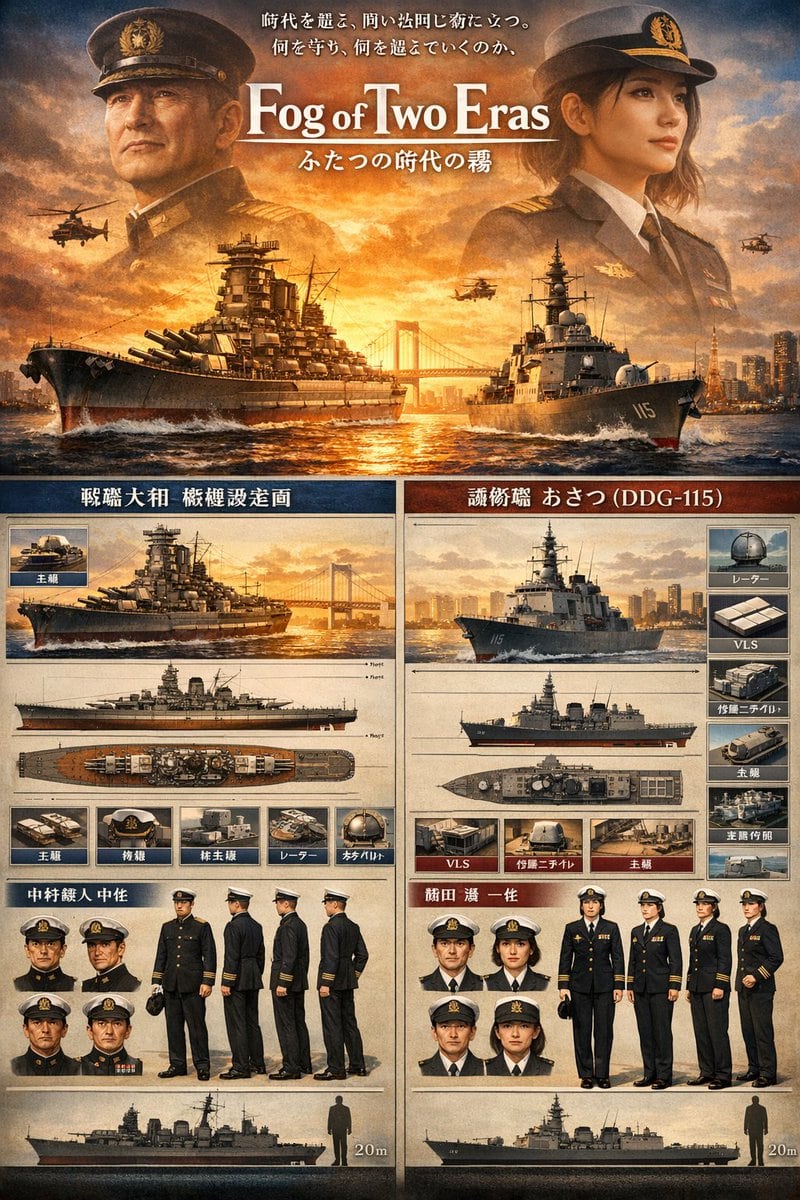
PromptCreate a cinematic Japanese naval comparison poster in a highly detailed, photorealistic concept-art style with a warm amber sunset palette, dramatic clouds, glowing backlight, and a premium movie-poster plus technical-reference-sheet layout. The composition is vertically stacked in 2 main zones. In the top hero zone, show 2 large semi-transparent officer portraits facing inward, one on the left in an older imperial-era naval uniform and one on the right in a modern maritime self-defense force style dress uniform, both wearing peaked caps and formal dark coats, with a blazing sunset sky behind them. Centered between them, place a large serif English title reading {argument name="headline text" default="Fog of Two Eras"}, with a smaller Japanese subtitle beneath it reading ふたつの時代の霧, and 2 lines of Japanese tagline text above the title. Below the title, on the ocean at golden hour, show 2 warships moving forward on slightly converging paths: on the left, a massive World War II-era battleship with many large gun turrets, tower superstructure, weathered dark hull, and white bow spray; on the right, a modern gray guided-missile destroyer with hull number 115 visible on the bow, sleek radar-equipped superstructure, and foamy wake. Add exactly 4 helicopters in the sky, 2 on the left side and 2 on the right side, plus a suspension bridge and distant modern city skyline on the horizon. In the lower reference-sheet zone, split the page into 2 vertical panels, left for the historical ship and right for the modern ship, each panel styled like a parchment-toned military specification board with dark blue and dark red header bars, fine dividing lines, inset image boxes, and Japanese labels. The left panel should present exactly 1 large perspective render of the battleship, 3 orthographic ship views beneath it, 5 small labeled equipment/detail thumbnails in a row, 4 small head-and-shoulders uniform portraits, 4 full-body character turnaround views of a male naval officer, and 1 bottom scale silhouette of the ship beside a human figure with a 20m marker. The right panel should present exactly 1 large perspective render of the modern destroyer, 3 orthographic ship views beneath it, 6 small labeled equipment/detail thumbnails arranged around the ship references, 4 small head-and-shoulders uniform portraits, 4 full-body character lineup views including a central female officer in white cap and dark uniform, and 1 bottom scale silhouette of the ship beside a human figure with a 20m marker. Use visible Japanese headers and labels throughout, including a left historical title area and a right title area naming the ship as 護衛艦 あさつ (DDG-115). Make the whole image feel like a museum exhibition poster, military design sheet, and prestige historical sci-fi drama key art combined, with ultra-sharp detail, realistic metal textures, ocean reflections, aged paper panels, symmetrical balance, and polished editorial typography.
Prompt structure- Modelgpt-image-2
- Use casecampaign-poster
- Stylecinematic, photorealistic, 3d-render, editorial
- Aspect ratioFlexible
Best used for- Use casecampaign-poster
- Stylecinematic, photorealistic, 3d-render, editorial
- Recommended specs1:1, 4:5, 16:9, or 9:16
- ModelGPT Image 2
How to customizeUse this Create A Cinematic Japanese Naval Comparison Poster In A Highly Detailed prompt as a base. Replace the subject, product details, environment, lighting, brand colors, and output ratio while keeping the campaign-poster intent and cinematic, photorealistic, 3d-render, editorial direction stable.
Editable variables- SubjectReplace the product, person, scene, interface, or object being generated.
- Use caseKeep or rewrite the destination as campaign poster, ad creative, cover image, poster, or ecommerce hero.
- FrameChoose 1:1, 4:5, 16:9, or 9:16 based on the final placement.
- Brand cuesAdd colors, materials, props, text-safe space, and the platform where the image will be used.
Recommended specsChoose the frame for the destination first, then use 1K, 2K, or 4K based on output quality needs. Product images and posters usually benefit from higher resolution.
Pre-generation checklist- CheckSubject, lighting, composition, and frame are specific enough to review.
- CheckText-safe space is included when the image will carry a headline or ad copy.
- CheckResolution, credit cost, and final destination are checked before generation.
Why this prompt worksCreate A Cinematic Japanese Naval Comparison Poster In A Highly Detailed works because it starts from the image job, then controls subject, composition, lighting, style, and frame. It is best for campaign poster while keeping the cinematic, photorealistic, 3d-render, editorial direction stable.
Common questions- Can I use it directly?Yes. Replace the subject, brand cues, and frame, then generate in Image2Studio.
- Which ratio should I use?Choose 1:1, 4:5, 16:9, or 9:16 based on the destination.