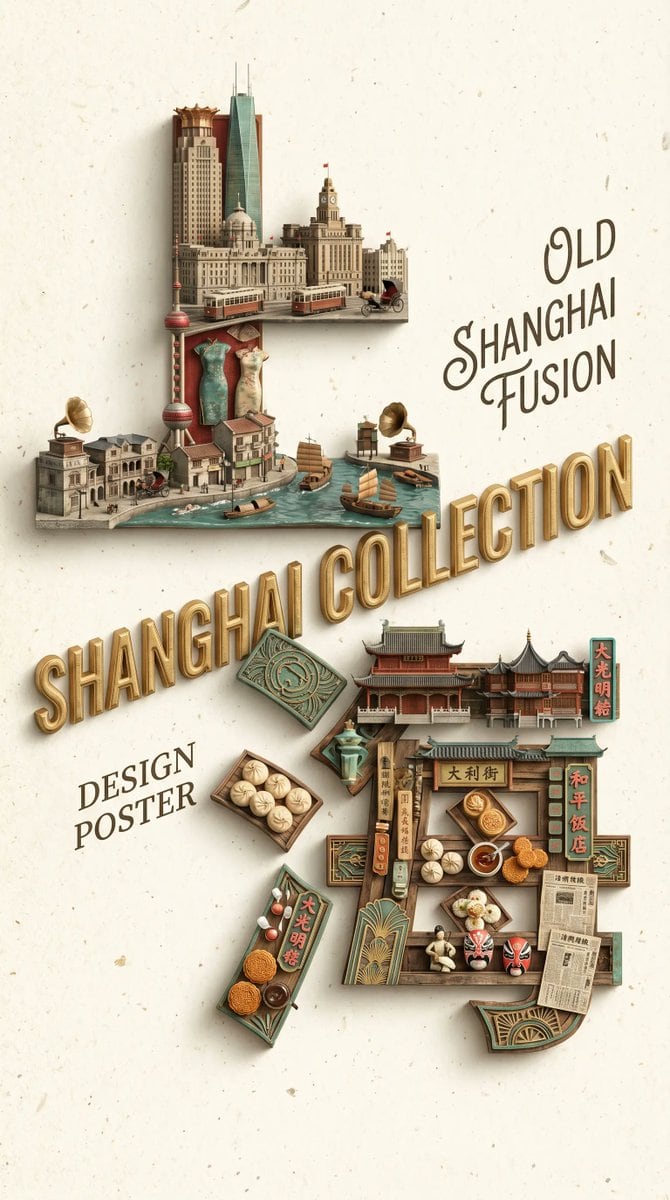
PromptA vertical cultural travel poster on warm off-white textured paper, designed like a handcrafted 3D shadow-box collage that forms the silhouette of the Chinese character for Shanghai. Use a refined old-meets-new Shanghai theme with miniature architecture, street scenes, props, food, and typography, photographed straight-on with soft studio lighting and delicate drop shadows. The composition should feel elegant, editorial, nostalgic, and premium, with muted cream, brass gold, teal green, brick red, jade, and weathered wood tones. At the upper left, build the top section of the character from 1 modern glass skyscraper, 1 tall historic high-rise with a golden crown, 1 domed neoclassical waterfront building, 1 clock-tower civic building, 2 smaller background towers, 2 red vintage Shanghai trams, and 1 rickshaw. Beneath that, create a canal-town section with 2 tall red Oriental Pearl Tower spheres-and-columns motifs, 2 qipao dresses displayed vertically, 4 old shikumen and lane houses, 1 curved waterfront canal, 4 wooden boats on the water, and 2 gramophones placed at the far left and right edges. Across the center, place a large diagonal metallic-gold embossed title reading {argument name="headline text" default="SHANGHAI COLLECTION"} in bold retro 3D lettering. To the right of the upper composition, add hand-lettered vintage script text reading {argument name="subtitle text" default="OLD SHANGHAI FUSION"}. On the lower left, add serif text reading {argument name="tagline text" default="DESIGN POSTER"}. The lower half should form the rest of the character using traditional Chinese architectural miniatures and market objects: 1 large classical Chinese roofed building complex, 4 vertical neon-style shop signs with Chinese characters, 2 square decorative plaques, 1 small green ceramic ewer, 2 shallow food trays, 1 rectangular tray of 6 soup dumplings, 1 long tray with 3 white tanghulu-like skewered sweets, 2 round mooncakes, and 1 small sauce dish, 1 rectangular display shelf containing 4 steamed buns, 1 bowl of noodles, 2 golden pastries, 1 plate of white flower-shaped sweets, 1 small doll figurine, and 2 painted opera masks, plus 2 hanging newspapers at the lower right. Keep the background spacious and minimal, with the collage and text arranged diagonally for a sophisticated poster layout. Make the whole image look like a meticulously assembled handmade paper-and-wood diorama, combining Art Deco Shanghai glamour, Republican-era nostalgia, Jiangnan water-town charm, and traditional Chinese market culture.
Prompt structure- Modelgpt-image-2
- Use casebrand-identity
- Styleluxury, 3d-render, editorial, isometric
- Aspect ratioFlexible
Best used for- Use casebrand-identity
- Styleluxury, 3d-render, editorial, isometric
- Recommended specs1:1, 4:5, 16:9, or 9:16
- ModelGPT Image 2
How to customizeUse this Old Shanghai Fusion Poster prompt as a base. Replace the subject, product details, environment, lighting, brand colors, and output ratio while keeping the brand-identity intent and luxury, 3d-render, editorial, isometric direction stable.
Editable variables- SubjectReplace the product, person, scene, interface, or object being generated.
- Use caseKeep or rewrite the destination as brand identity, ad creative, cover image, poster, or ecommerce hero.
- FrameChoose 1:1, 4:5, 16:9, or 9:16 based on the final placement.
- Brand cuesAdd colors, materials, props, text-safe space, and the platform where the image will be used.
Recommended specsChoose the frame for the destination first, then use 1K, 2K, or 4K based on output quality needs. Product images and posters usually benefit from higher resolution.
Pre-generation checklist- CheckSubject, lighting, composition, and frame are specific enough to review.
- CheckText-safe space is included when the image will carry a headline or ad copy.
- CheckResolution, credit cost, and final destination are checked before generation.
Why this prompt worksOld Shanghai Fusion Poster works because it starts from the image job, then controls subject, composition, lighting, style, and frame. It is best for brand identity while keeping the luxury, 3d-render, editorial, isometric direction stable.
Common questions- Can I use it directly?Yes. Replace the subject, brand cues, and frame, then generate in Image2Studio.
- Which ratio should I use?Choose 1:1, 4:5, 16:9, or 9:16 based on the destination.